Understanding, Coping With, and Transforming Relationship Imbalance
When two people genuinely care for each other — but not equally. Not with the same intensity. Not at the same speed. This book explores both sides of that gap: the one who leans in, and the one who pulls back.
Relationship imbalance looks entirely different depending on which side you're standing on. The pain is real on both sides — and so is the confusion. The Imbalance of Like is one of the only books to explore both experiences with equal compassion and honesty.
You check your phone more often than you'd like to admit. You craft messages carefully, then second-guess them. You remember details they've already forgotten. You've told yourself to care less — and it hasn't worked.
You genuinely like this person. But something in you resists matching their level of intensity. You feel guilty about this — maybe even confused by it. You don't want to hurt them, but you also can't manufacture feelings you don't have.
Both experiences are explored in this book with equal honesty and care. You are not the villain of the other person's story. You are a person with patterns — and patterns can be understood.
What if the very thing
that's been breaking your heart
is actually breaking you open?
There's a particular kind of heartbreak that doesn't fit neatly into the categories we usually talk about. It's not the dramatic end of a long relationship, the betrayal of infidelity, or the clear-cut incompatibility that makes breaking up obvious. It's subtler, more confusing, and often more painful — because both people are telling the truth about how they feel, and those truths simply don't match. The Imbalance of Like names this dynamic clearly — and shows both partners a path forward.
Real case studies, practical exercises, and unflinching honesty — for both partners in the imbalance. Each chapter explores how the dynamic looks and feels from each side.
The anatomy of unequal investment. How to recognize the signs — in yourself and in the dynamic — and understand emotional labor from both perspectives.
Past wounds, attachment styles, and the invisible patterns that shape why some people lean in too far — and why others pull away before they're fully in.
Emotional erosion over time. What repeated disappointment does to the longing partner — and what the weight of someone else's unmet needs does to the reserved partner.
When the imbalance finally erupts. The longing partner's desperation, the reserved partner's defensive response — and what each person needs to hear in that moment.
Recovery. How both partners find their way back to themselves — reclaiming worth, setting boundaries, and building the internal resources that make healthier love possible.
When to fight for a relationship — and when letting go is the most loving thing either person can do. The crossroads conversation from both sides of the table.
What healthy, conscious love actually looks like — and the practice of building it. For both partners, a vision of what becomes possible when the patterns are understood.
What if the very thing that's been breaking your heart is actually breaking you open to receive the love you truly deserve?
The hardest moments don't schedule themselves. A spiral at 2am. A conversation you're dreading. A pattern you keep repeating and can't understand. The AI companion is trained on this book — and it's here for both of you.
Joel Shakespear is an entrepreneur, creator, and deeply curious human who has spent a lifetime exploring the hidden dynamics that shape how we love, connect, and relate. Known for his thoughtful insights, authentic voice, and willingness to confront uncomfortable truths, Joel brings a unique blend of personal experience, hard-won wisdom, and practical guidance to The Imbalance of Like.
For years, Joel observed the quiet but painful pattern that so many experience but few discuss — what happens when we find ourselves caring more, giving more, and waiting more in relationships where the emotional scales tip unevenly. He has also lived the other side: the weight of being unable to fully match someone's investment, and the confusion and guilt that comes with that. Both experiences are in this book.
Rather than dismissing these feelings, he chose to investigate them deeply — ultimately giving voice to a phenomenon that resonates with countless people on both sides of the imbalance. Beyond writing, Joel is the founder of several innovative ventures, a passionate advocate for personal growth, and an avid student of human behavior and psychology.
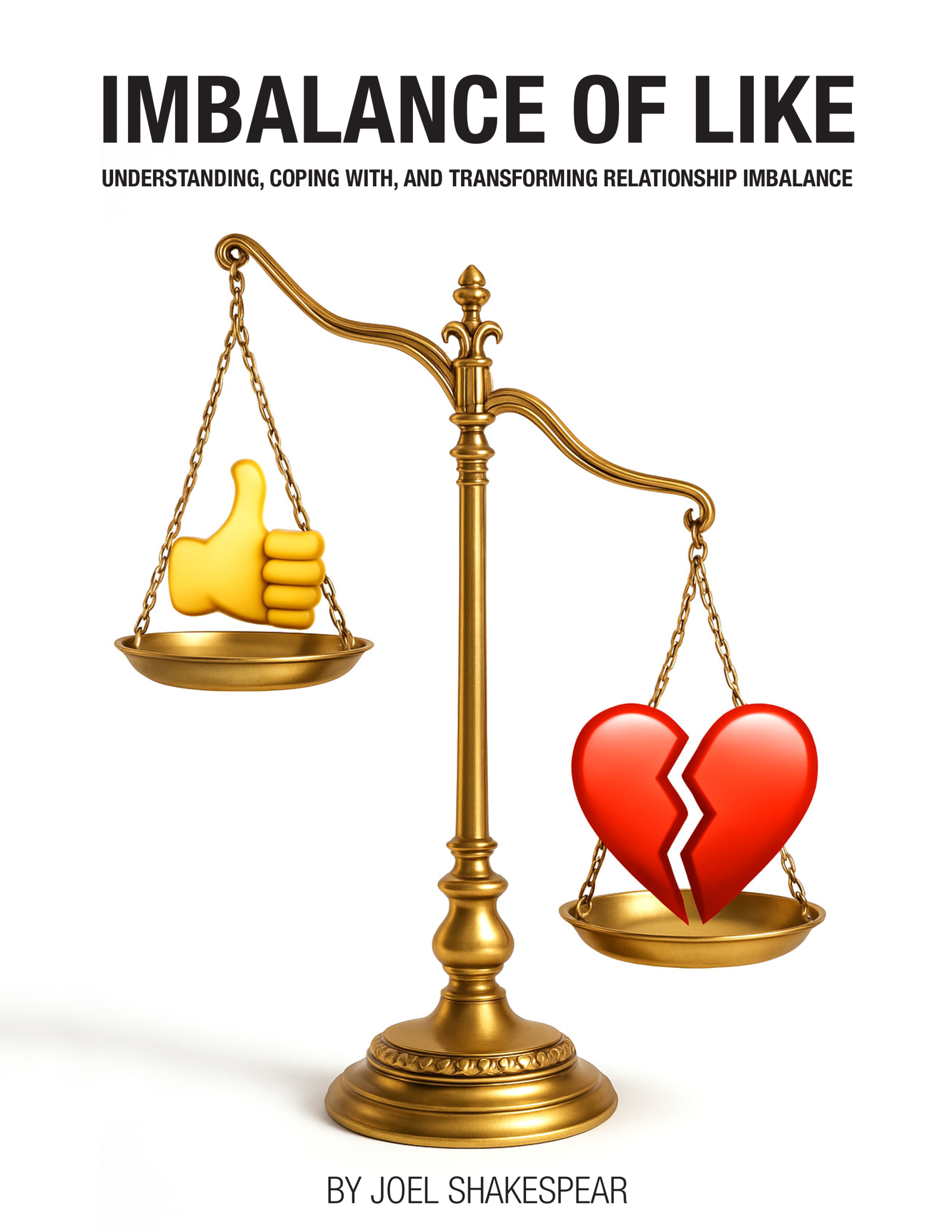
Questions organized by perspective — whether you're the one who invests more, the one who pulls back, or trying to understand the dynamic from the outside.
The persistence of the longing partner's investment despite unequal return is rooted in several psychological forces: intermittent reinforcement (the unpredictable warmth that comes just often enough to sustain hope), attachment patterns formed long before this relationship, and the way the brain processes romantic bonding as a reward system that doesn't simply switch off.
The book explores why caring more doesn't make you weak or foolish — it makes you someone with a specific attachment style and specific patterns, both of which can be understood and, over time, redirected toward relationships where the investment is matched.
The most reliable signal is consistency over time, not individual moments. In an imbalanced relationship, you are reliably the one initiating contact, suggesting plans, bringing up meaningful conversations, and managing the emotional temperature of the connection. The other person's warmth is real — but it's reactive rather than generative. They respond; they rarely initiate.
The book offers specific frameworks for distinguishing genuine imbalance from anxiety-driven overthinking — including the difference between someone who is reserved by nature and someone who is simply less invested in you specifically.
Because investment level is rarely about effort — it's about emotional availability, attachment style, and where someone is in their own emotional development. When you try harder, you often inadvertently signal that the current level of investment is acceptable, which reinforces the pattern rather than shifting it.
More effort from the longing partner frequently creates more distance from the reserved partner, not less — because the reserved partner experiences intensity as pressure rather than connection. The book explains this dynamic and why changing the pattern requires a fundamentally different approach than working harder.
The book doesn't prescribe a universal answer because the right answer depends on factors specific to your situation: how long the imbalance has existed, whether the reserved partner is capable of and willing to grow toward more reciprocity, what the cost of staying has been to your sense of self, and whether the relationship has a foundation of genuine compatibility beyond the emotional imbalance.
Chapter 6 (The Crossroads) addresses this directly — including the kinds of conversations that can reveal whether transformation is possible, and the signals that suggest letting go is the more loving choice for both people.
Recurring patterns in relationship selection are almost always rooted in attachment history — specifically, what felt "normal" or familiar in your early experiences of love and connection. If you grew up earning connection through effort, emotional labor, or by managing other people's needs, you may unconsciously select partners who require that dynamic to feel recognizable as relationships.
The book explores the archaeological work of understanding these patterns — not to blame your past, but to see how it shapes your present, and to begin choosing differently from a place of awareness rather than repetition.
The hyper-vigilance the longing partner experiences — the phone checking, the response-time analysis, the parsing of word choices — is not a character flaw. It's a natural response to emotional uncertainty. When connection feels conditional or unreliable, the brain goes into a scanning mode, looking for information that will resolve the anxiety.
The solution is not willpower or telling yourself to stop. It's addressing the underlying uncertainty — either by having the direct conversation about where you both stand, or by accepting that the uncertainty itself is the answer. The book offers tools for both paths.
The reserved partner's withdrawal in the face of closeness is almost always a protective response — not a choice, and not a character flaw. It is often rooted in a fear of emotional engulfment (the sense that someone else's needs will consume you), in an attachment style that learned early that closeness brings loss or overwhelm, or in past experiences that made vulnerability feel unsafe.
The pull toward distance is often unconscious. You may not even recognize it's happening until you notice the relief you feel when a conversation ends, or the low-level dread that builds when someone expresses strong feelings for you. The book explores where this comes from and what it costs you.
No. Emotional investment develops at different speeds for different people, and some people have attachment styles that make deep connection genuinely more difficult — not because they are broken, but because of how they learned to protect themselves. The reserved partner is not cold, unfeeling, or incapable of love.
What is worth examining is whether the distance you maintain is serving you — or whether it's a pattern that consistently costs you relationships you actually want, leaving you with a sense of connection that never quite reaches the depth you suspect might be possible.
This is one of the most disorienting experiences the reserved partner describes — the way that increased affection from the other person paradoxically creates increased desire for distance. This happens because emotional intensity, for someone with an avoidant or dismissing attachment style, registers as pressure rather than safety.
The closeness that the longing partner offers as reassurance is experienced by the reserved partner as a demand — for reciprocity they're not sure they can provide, for emotional depth that feels overwhelming, for a level of commitment that triggers fear of losing autonomy. The book explains the neuroscience and psychology behind this response.
The guilt the reserved partner carries is real and often heavy — the sense that you are failing someone who genuinely deserves more, that your inability to match their investment is a form of cruelty, even when it's entirely unintentional. This guilt is worth taking seriously, not as self-punishment, but as information.
It tells you that you do care about this person. It also tells you there's a gap between what you want to offer and what you're currently able to. The book helps you examine what's actually in the way — and whether the capacity for more closeness exists within you, currently blocked, or whether the honest answer is that this relationship isn't the right fit regardless of how much you wish it were.
Yes — attachment styles are not fixed. Research consistently shows that avoidant attachment patterns can shift toward more secure attachment through self-awareness, intentional practice, and relationships (including therapeutic ones) that provide consistent safety without pressure. The key word is intentional: this doesn't happen passively or simply through finding "the right person."
The book's final chapters address what growth looks like for the reserved partner specifically — not becoming someone who performs more connection, but genuinely expanding the capacity for closeness in a way that feels authentic rather than performed.
Most relationship books address one perspective — typically the person who was hurt, left, or invested more. The Imbalance of Like is one of the few books that explores both sides with equal seriousness and compassion. The reserved partner's inner experience — the guilt, the confusion, the fear — receives as much attention as the longing partner's pain.
The book also focuses specifically on relationship imbalance as a distinct phenomenon, rather than treating it as a subcategory of heartbreak or toxic relationships. It is not about bad people. It is about two people with genuinely different emotional investment levels — and what both of them can do with that reality.
The AI companion is trained exclusively on The Imbalance of Like — its frameworks, case studies, exercises, and voice. It is not a generic AI assistant. It only draws from this book, which means its responses are grounded in the specific concepts and language of Joel Shakespear's work rather than generic relationship advice from the internet.
It is free to use, requires no signup, and is available at any hour. On this page, tap Open the companion or the button at the lower right. For a larger window, use the companion page.
No — and it doesn't try to be. The AI companion is a reading companion and framework guide, not a mental health resource. It can help you apply the book's concepts to your specific situation, process what you've read, and work through the exercises. For deeper emotional work — particularly if you're dealing with trauma, anxiety, depression, or complex relationship history — a qualified therapist is the appropriate resource.
The companion is best understood as the book becoming interactive: instead of reading a chapter and sitting with the questions alone, you can engage with them in conversation.
The Imbalance of Like is available on Amazon in both print and Kindle formats. Print ISBN: 9798287983321. Both formats are available for immediate purchase or Kindle Unlimited.
Absolutely — and many readers find it most valuable when they're not in the middle of an imbalanced dynamic. Reading the book outside of an active situation allows you to see your patterns more clearly, understand your own attachment style without the distorting pressure of current feelings, and build self-awareness that changes how you enter future relationships.
If you've had a recurring pattern of relationship imbalance — consistently ending up as the longing partner, or consistently pulling back as the reserved partner — this book will be relevant regardless of your current relationship status.
Occasional notes on relationship patterns, new resources, and what comes next. No noise. No spam. Unsubscribe anytime.